Last checked: 5 October 2026
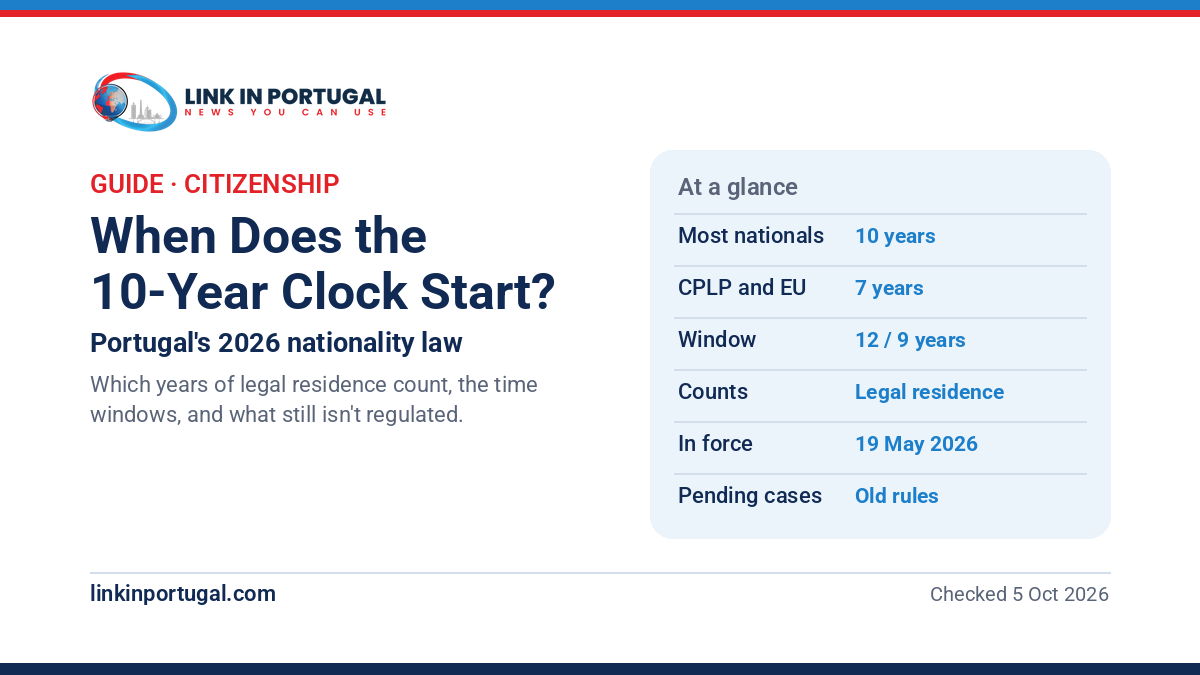
Portugal’s new nationality rules came into force on 19 May 2026. The headline change is the waiting time: 10 years of legal residence for most people, or 7 years for nationals of Portuguese-speaking countries and EU citizens. But the bigger question for many readers is when the clock starts and which years count. This guide goes through the law article by article.
This is general information, not legal advice. Several points still depend on rules the Government hasn’t published. For your own case, ask IRN or a lawyer or solicitor. For the full list of requirements, see Portuguese citizenship: requirements and the new 2026 law.
The rule in one line
To naturalise, an adult must have lived legally in Portugal for at least 7 years (nationals of Portuguese-speaking countries and EU citizens) or 10 years (everyone else), on the date of the application (Nationality Law, article 6(1)(b), as amended by Lei Orgânica n.º 1/2026, of 18 May). Stateless people need 4 years (article 6(3)).
| You are | Years of legal residence | Must fall within |
|---|---|---|
| National of a Portuguese-speaking country (CPLP) or EU citizen | 7 | a 9-year window |
| National of any other country (for example Pakistan, India, Bangladesh, Nepal) | 10 | a 12-year window |
| Stateless | 4 | a 6-year window |
When your clock starts now
Article 15(1) says you live legally in Portugal when you are here with your situation regularised, under any of the titles, visas or permits of the Foreigners Law or the asylum law. Agreements such as those of the EU and the CPLP keep their own special rules (article 15(2)).
The old article 15(4) is revoked (Lei Orgânica 1/2026, article 5). That was the rule that let you count time from the date you applied for your first residence permit, if it was later granted. Without it, the time you spent waiting for AIMA to decide your first permit no longer counts on that basis.
What we couldn’t confirm: the law doesn’t say which date on a card counts (the decision date, the issue date or the start of validity). The updated Nationality Regulation should explain the evidence; until then, keep every visa, card and AIMA decision, and ask IRN how it reads your dates.
The time window: years must add up within 12 (or 9) years
Your periods of legal residence are added up, continuous or with breaks, as long as they all fall within a maximum window of 12 years (other nationals), 9 years (CPLP and EU) or 6 years (stateless) (article 15(3)). So a 10-year requirement allows up to 2 years of gaps, and a 7-year one up to 2 years, inside the window.
Example: Ravi Kumar entered Portugal in 2022, applied for a permit under manifestação de interesse, and received his first residence permit on 1 February 2024. He has renewed on time ever since. Under the new law, his clock is based on his permits, so if nothing interrupts it he reaches 10 years of legal residence in February 2034, well inside the 12-year window. If he had a 1-year gap between two permits, he would need until February 2035, and the 10 years would still fit within 12.
Applied before 19 May 2026? The old rules apply
Applications that were already pending when the new law came into force continue under the old Nationality Law (Lei Orgânica 1/2026, article 7(2)). The Ministry of Justice confirms that the new rules apply only to applications submitted after 19 May 2026. To follow a pending case, see how to check your citizenship application status.
Does time on an expired card or a pending renewal count?
The law counts time when your situation is regularised under a title, visa or permit. It doesn’t mention renewal receipts or the proof of a pending process. AIMA has said that people with a renewal pending a final decision are not in an irregular situation, but that is a statement about your stay, not about nationality counting. We found no official guidance from IRN on this point (5 October 2026).
- Renew on time, so gaps don’t appear in the first place. Our AIMA renewal dates tool shows when to apply, and our renewal guide explains the portal.
- Keep your renewal receipts, the process-status PDF and the approval proof. They may be needed to show there was no break.
- If you had a long gap between cards, ask a lawyer before you apply.
Does manifestação de interesse waiting time count?
A manifestação de interesse (MI) was a request, not a residence title. With article 15(4) revoked, the law has no rule that counts the waiting time before your permit was granted. We found no official guidance that MI waiting time counts under the new law. If your case depends on those years, get advice before you apply.
The new knowledge test: what we know and what isn’t set yet
- Applicants must prove, by a test or a certificate, sufficient knowledge of the Portuguese language and of Portuguese culture, history and national symbols (article 6(1)(c)), plus the fundamental rights and duties of citizens and how the state is organised (article 6(1)(d)).
- Nationals of Portuguese-speaking countries are presumed to meet the language part, unless their lack of Portuguese is obvious (article 6(10)).
- The law gave the Government 90 days to update the Nationality Regulation (Decree-Law 237-A/2006) (Lei Orgânica 1/2026, article 4). That deadline passed in mid-August 2026, and we couldn’t find a published update in the Diário da República as of 5 October 2026.
- So the format, provider and fee of the new culture, history and civics test aren’t defined yet. Be wary of anyone selling an “official” practice test.
The language part still works as before: see the Portuguese A2 test for citizenship.
Children born in Portugal: the 5-year parent rule
- Portuguese from birth (by declaration): a child born in Portugal to foreign parents can be Portuguese if a parent declares it and, at the time of the birth, one parent had lived legally in Portugal for at least 5 years (article 1(1)(f)).
- Naturalisation of a minor born in Portugal: possible if, when the application is made, one parent has lived legally in Portugal for at least 5 years, the child is enrolled in and attending compulsory school where applicable, and, from the age of criminal responsibility, the child meets the conduct requirements (article 6(2)).
Your other nationality: check your own country’s rules
Giving up your current nationality isn’t one of the requirements in article 6, and the Nationality Law accepts that a person can hold two or more nationalities (for Portuguese law, only the Portuguese one counts: article 27). Whether your own country lets you keep it is decided by that country’s law, and the rules differ for Pakistan, India, Bangladesh, Nepal and Brazil. Check the official website of your country’s government or embassy before you apply, because losing a nationality can affect property, inheritance and travel.
Other changes in the 2026 law
- The special route for descendants of Sephardic Jews has ended, and great-grandchildren of Portuguese citizens can now apply (Ministry of Justice summary).
- New conditions include a solemn declaration of commitment to the democratic rule of law, no prison sentence of more than 3 years for certain serious crimes, and being able to support yourself (article 6(1)(e) to (i)).
- The law was corrected by Declaração de Retificação n.º 17/2026, according to the Ministry of Justice.
Many people who can’t yet apply for citizenship can ask for permanent residence first.
FAQ
Is Portugal citizenship now 10 years?
Yes, for nationals of non-Portuguese-speaking, non-EU countries who apply after 19 May 2026. CPLP and EU nationals need 7 years.
Does my time as a student or on a work visa count?
Article 15(1) covers any title, visa or permit under the Foreigners Law, so legal periods on those count, subject to the window rule. Keep the documents that prove each period.
I had 5 years and applied in April 2026. Am I affected?
No. A pending application follows the old law (article 7(2)).
Where do I apply?
Through IRN. The Ministry of Justice explains how to submit a nationality application.
Has the new test started?
Not as far as we can find. Its rules have to be set in the updated Regulation, which we couldn’t find published as of 5 October 2026.
Official sources
- Diário da República – Lei Orgânica n.º 1/2026, de 18 de maio (PDF)
- Diário da República – Lei Orgânica n.º 1/2026, record page
- Diário da República – Lei da Nacionalidade, consolidated text
- Justiça – Lei da Nacionalidade: novas regras entram em vigor a 19 de maio
- Justiça – Submeter pedido de nacionalidade
This guide is general information, checked against official sources on 5 October 2026. Rules and portals in Portugal change often, so confirm the current rules with the official source before you act. It is not legal or tax advice. Link in Portugal isn’t connected to IRN or any government body.