Last checked: 5 October 2026
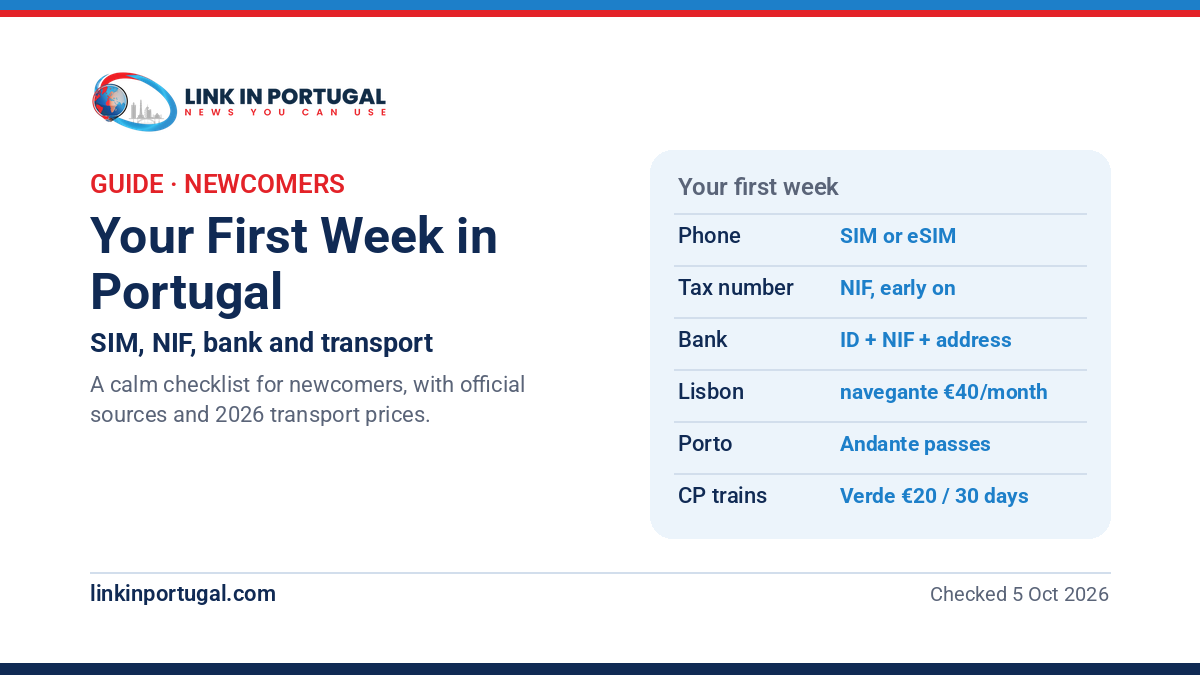
Welcome to Portugal! The first days can feel like a lot, with new numbers, new offices and new cards. This guide covers four things that make everything else easier: a phone connection, a tax number (NIF), a way to hold and spend money, and getting around.
This is general information, not legal or tax advice. Rules and office procedures change. Always check the official pages linked below.
At a glance
| Step | What you need it for | When |
|---|---|---|
| Mobile data / phone number | Maps, messages, SMS codes from banks and public services | Day 1 |
| NIF (tax number) | Renting, work contracts, bank accounts, most contracts and invoices | As early as you can |
| A way to pay and get paid | Rent deposits, daily spending, receiving a salary | Week 1 |
| Transport card | Cheaper daily travel | Week 1 |
1. Get connected: short-term data first, then a Portuguese number
For your first days, roaming on your home plan or a travel eSIM gets you online the moment you land, before you’ve found a phone shop. It’s useful for maps, messaging apps and booking appointments. If you choose an eSIM, check that your phone supports it and read what the plan includes before you buy.
For living here, get a Portuguese SIM or eSIM from a local operator once you’re settled. A Portuguese number helps with local SMS codes, deliveries, employers and landlords. Compare prepaid and monthly plans. For independent consumer information about phone services, see ANACOM’s consumer portal.
2. Get your NIF (Número de Identificação Fiscal)
The NIF is your Portuguese tax number. Official gov.pt guidance says you need it to work, open a bank account, sign contracts and buy goods or services with a tax invoice. Anyone can ask for one, resident or not.
Option A: the joint “three numbers” service at an Espaço Cidadão
Foreign nationals with a Portuguese address can ask for the NIF, NISS (social security number) and SNS user number (health) in one go. According to gov.pt (updated 17.09.2026), this is currently offered at 12 Espaços Cidadão. It’s for people without a Portuguese Cartão de Cidadão who meet one of these conditions:
- have applied for or already hold a residence permit;
- are nationals of an EU country;
- have applied for international protection;
- have refugee status or international protection.
Use gov.pt’s Locais de atendimento search to find a participating Espaço Cidadão near you.
Option B: at a Finanças office (by appointment)
Counter service for the NIF is by appointment. You can book:
- online on the Portal das Finanças, using the option for a NIF request by people without a Cartão de Cidadão (no login needed);
- by phone on (+351) 217 206 707, working days 9:00–19:00.
Documents listed on gov.pt:
- Non-EU nationals who want to be tax residents: passport or ID plus a valid residence permit.
- EU nationals who want to be tax residents: ID or passport plus the EU citizen registration certificate (from the câmara municipal).
- Non-residents: ID or passport. The AT leaflet adds a document showing your address abroad, if it isn’t on your ID.
- If you show a passport, the gov.pt guide says to bring the entry visa for Portugal or the Schengen area as well. The AT leaflet notes exceptions, for example for visa-exempt nationalities.
Option C: through a representative, online
If you live outside the EU, Norway, Iceland or Liechtenstein, a legal representative with a power of attorney can ask for your NIF through the e-balcão on the Portal das Finanças.
Cost
The gov.pt guide for foreigners says the NIF request is free. The gov.pt service page adds that there can be costs in some cases, for example when a fiscal representative makes the request. Representatives and lawyers set their own fees.
Do you need a fiscal representative?
This is where official sources differ, so read carefully:
- The gov.pt service page (updated 01.09.2026) says that non-EU nationals who register as non-residents must name a fiscal representative in Portugal.
- The tax authority’s own leaflet for non-resident foreigners (AT, July 2025) says a representative is not required at the moment the NIF is issued.
- Under the AT leaflet, if you later create a tax relationship (for example you own a car or property in Portugal, sign a work contract here, or work self-employed here), you have 15 days to either name a fiscal representative or sign up for electronic notifications (Portal das Finanças notifications or ViaCTT).
- The AT leaflet says this is optional for residents of the EU, Norway, Iceland and Liechtenstein, and for Andorran citizens living in Andorra.
- The AT leaflet also says non-residents from other countries who work self-employed in Portugal must name a VAT fiscal representative before they start.
- Once you meet the conditions to be a tax resident in Portugal, the AT leaflet says you must ask Finanças to update your address.
Confirm at Finanças which rule applies to you, or ask a certified accountant (contabilista certificado).
Already have your number? Check that it’s typed correctly (for example on a contract or invoice) with our free NIF Validator. It checks the format and check digit only. It doesn’t confirm that the number exists or who owns it; only Finanças can do that.
3. Money: until your Portuguese account is ready
Portuguese banks will ask for a tax number. Banco de Portugal’s rules list what a bank must collect to open a current account:
- a valid ID with photo and signature;
- your NIF (or an equivalent number issued abroad);
- proof of your permanent address;
- your profession and employer, if you have them.
In practice, most newcomers open a Portuguese account once they have a NIF and an address. Banco de Portugal also says that being unemployed or not having a profession shouldn’t, by itself, be a reason to refuse an account.
While you wait, you may be able to keep using a card or account from home. Before you do, check its foreign-currency and cash-withdrawal fees, and whether the exchange rate it uses is close to the mid-market rate.
Tips:
- Before opening a bank account, ask for the account’s standard information sheet (FIN) and the fee information document. Banks must give you both.
- Compare monthly maintenance fees. Some accounts charge them unless you meet conditions such as a salary paid in.
- Never share bank codes or one-time passwords with anyone who calls or messages you.
Starting a job? See roughly what your gross salary means in take-home pay with our free Net Salary tool.
4. Getting around
Lisbon area: navegante
Monthly passes for the Lisbon Metropolitan Area, from the official 2026 price table published by Transportes Metropolitanos de Lisboa:
| Pass | Covers | 2026 price |
|---|---|---|
| navegante Metropolitano | All regular public transport in the 18 municipalities of the Lisbon area | €40.00 / month |
| navegante Municipal (e.g. navegante Lisboa) | All public transport within one municipality | €30.00 / month |
| navegante Família | Households pay at most the equivalent of two passes | €80 (Metropolitano) / €60 (Municipal) |
The same table lists €0 versions for under-18s and under-23s (Sub18 / Sub23). Conditions apply, so check navegante.pt. Passes are valid for the calendar month.
Porto area: Andante
- Andante Azul (blue): paper card for occasional trips. €0.60 plus the trips you load. A single Z2 trip costs €1.40, and buying 10 single trips gets you 1 free.
- Andante Prateado (silver): personal card for monthly passes. €6.00 (€3.00 for students).
- Monthly passes (2026): 3 zones €30.00, Municipal €40.00, Metropolitano €40.00. Andante also lists special passes, for example for young people, over-65s and families. Check the conditions on andante.pt.
Validate every time you start a trip or change vehicle, including on the metro and train.
Trains across Portugal: CP and the Passe Ferroviário Verde
CP’s Passe Ferroviário Verde is for Portuguese citizens and foreign residents in Portugal. It costs €20 for 30 days, €40 for 60 days or €60 for 90 days, and is loaded onto a Cartão CP. Where it’s valid:
- Regional and InterRegional trains;
- Coimbra urban trains;
- since 27 September 2026, also Lisbon and Porto urban trains;
- Intercidades in 2nd class only, with a free seat reservation that you must make in advance.
The Government’s announcement says it doesn’t cover Alfa Pendular or Intercidades 1st class.
Get to know your new city
The official tourism offices have maps, transport tips and information on walking routes and guided visits. See Visit Lisboa and Visit Porto.
Looking ahead
- Social security (NISS): needed to work and to access benefits. Foreign nationals can ask for it online, or through the joint service above.
- Health: register at your local health centre (centro de saúde). The SNS 24 line is 808 24 24 24.
- Residence: AIMA’s checklist for a residence permit (article 77(1)) includes “health insurance or proof that you are covered by the National Health Service (SNS)”. Check AIMA’s page for the full, current list. To see which documents your residence case needs, try our free What Documents Do I Need? checklist.
- If your AIMA process is stuck: our free tool AIMA Stuck? Email Them Free helps you write a clear email to AIMA in Portuguese.
Example: Ravi Kumar arrives in Lisbon on a Monday. He gets online at the airport, books a Finanças appointment that evening for his NIF, buys a navegante pass, and switches to a Portuguese SIM by Friday.
This is general information, not legal or tax advice. Link in Portugal isn’t connected to any public body, bank or operator mentioned here.