
Last checked: 5 October 2026 · By Link in Portugal
After five years with temporary residence permits, you can ask for permanent residence in Portugal. There is also a second, EU-wide status for long-term residents. This guide compares the two, lists the requirements exactly as the Foreigners Law states them, explains how to apply at AIMA and how long the card lasts, and shows why permanent residence matters more now that citizenship takes longer.
This is general information, not legal advice. We checked the requirements against the consolidated Foreigners Law (Lei 23/2007, version updated by Law 62/2026) and AIMA’s own page. For your own case, especially with gaps in residence or a criminal record, speak to an immigration lawyer or solicitor.
Two statuses: national permanent residence vs EU long-term resident
| Permanent residence (art. 80) | EU long-term resident (arts. 125 to 131) | |
|---|---|---|
| Years needed | Holder of a temporary residence permit for at least 5 years | 5 years of legal, uninterrupted residence just before you apply |
| Portuguese | Basic Portuguese | Basic Portuguese |
| Money | Means of subsistence | Stable and regular resources for you and your family, without social assistance |
| Other | Accommodation; no prison sentence over 1 year in the last 5 years | Accommodation; health insurance |
| Card | Permit has no end date; card renewed every 5 years | EU long-term card valid at least 5 years, renewed on request |
| Lost if you are away | 24 months in a row, or 30 months in total within 3 years, without good reason | 12 months in a row outside the EU, or 6 years in a row outside Portugal |
| Extra | Can make it easier to move to another EU country under that country’s rules |
Some people can’t get the EU status, for example students, people under temporary protection and seasonal or posted workers (article 125). If you are not sure which fits you, ask a lawyer: the requirements are similar but not identical.
Requirements for permanent residence
Article 80 of the Foreigners Law says you get permanent residence if you meet all of these:
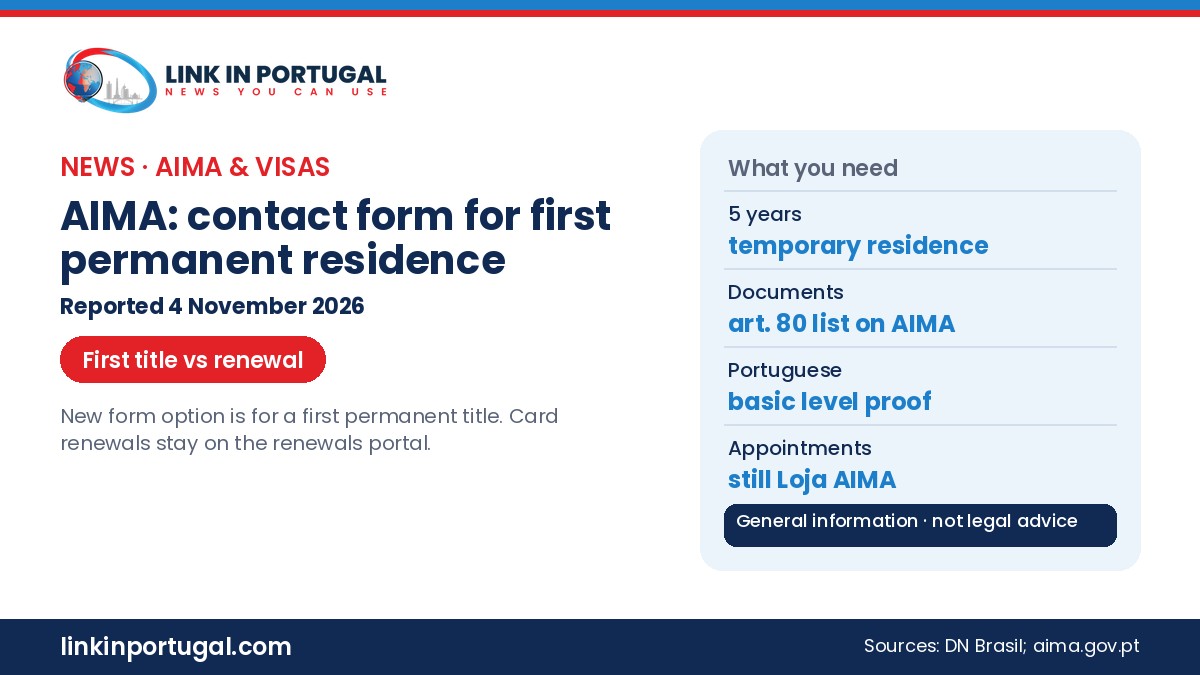
- you have held a temporary residence permit for at least five years;
- in the last five years of residence in Portugal you were not sentenced to prison terms that, alone or together, exceed one year (even if suspended, for some serious crimes);
- you have means of subsistence, as defined by the government order (portaria) on means;
- you have accommodation;
- you prove basic Portuguese.
AIMA’s page lists the ways to prove basic Portuguese. They include a Portuguese school certificate, schooling in a Portuguese-speaking country, the IEFP basic Portuguese course, a CAPLE test certificate (such as CIPLE) and an A2 or higher certificate from a Português Língua de Acolhimento (PLA) course. See our A2 test guide.
Documents AIMA asks for
According to AIMA
- a valid passport or other travel document;
- proof of means of subsistence;
- a declaration of your home address, saying on what basis you live there (owner, tenant, subtenant and so on). Owners add the land registry certificate or its access code; tenants add a statement from the landlord;
- proof that you have met your tax and Social Security obligations (see Social Security no-debt certificate);
- proof of five years as the holder of a temporary residence permit;
- proof of basic Portuguese;
- the AIMA form Modelo 1 (and Modelo 4, a term of responsibility, if it applies).
Our free document checklist helps you put the file together. If you rent, a registered lease and electronic receipts make the address part easier: see renting in Portugal.
How and where to apply in 2026
AIMA says the request is made by appointment, in person, at any Loja AIMA, with the signed form, by you or your legal representative. AIMA’s page doesn’t describe an online application for permanent residence. To ask for an appointment, use AIMA’s contact form or the channels on its contacts page; see how to book an AIMA appointment.
Plan ahead: you still need a valid temporary permit while you wait, so don’t let it expire. Our free renewal dates tool shows when your current card must be renewed (see residence permit renewal). Fees are set in AIMA’s fee table, linked from the same page.
For EU long-term resident status, the law says the request goes to the AIMA office for your area of residence (article 129). AIMA must decide within six months, extendable by three months in exceptional cases.
Card validity and renewal
- Permanent residence has no end date, but the card itself must be renewed every five years, or whenever your identification details change (article 76; AIMA says the same). When you renew, you don’t need to hand in documents AIMA already holds in its electronic workflow.
- EU long-term resident card: valid for at least five years and renewed on request when it ends (article 130). Under article 131(6), an expired card doesn’t by itself make you lose the status.
Long absences
Permanent residence can be cancelled if you are away from Portugal without good reason for 24 months in a row, or 30 months in total within three years (article 85(2)(b)). If you know you will be away longer, the law says to ask AIMA to justify the absence before you leave (or afterwards in exceptional cases). It is not cancelled if you prove you were working, running a business, or doing cultural or social work abroad.
The EU long-term status is lost after 12 months in a row outside the EU, or six years in a row outside Portugal, unless the absence is justified (article 131).
Did the 2025 and 2026 laws change permanent residence?
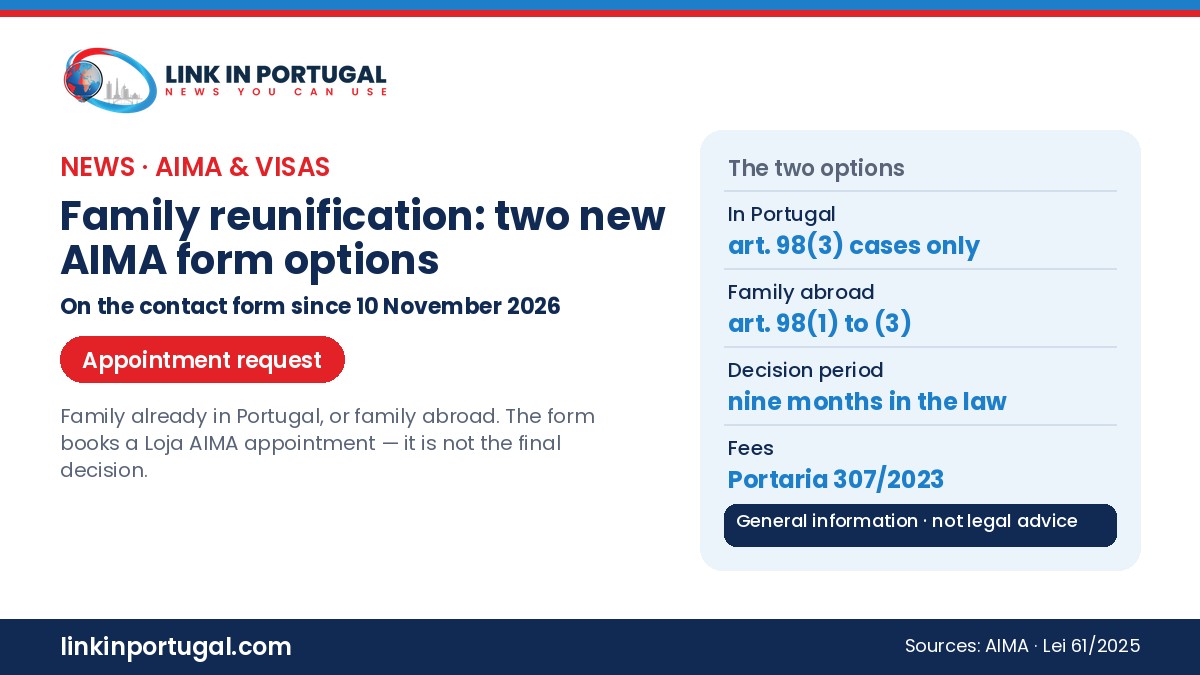
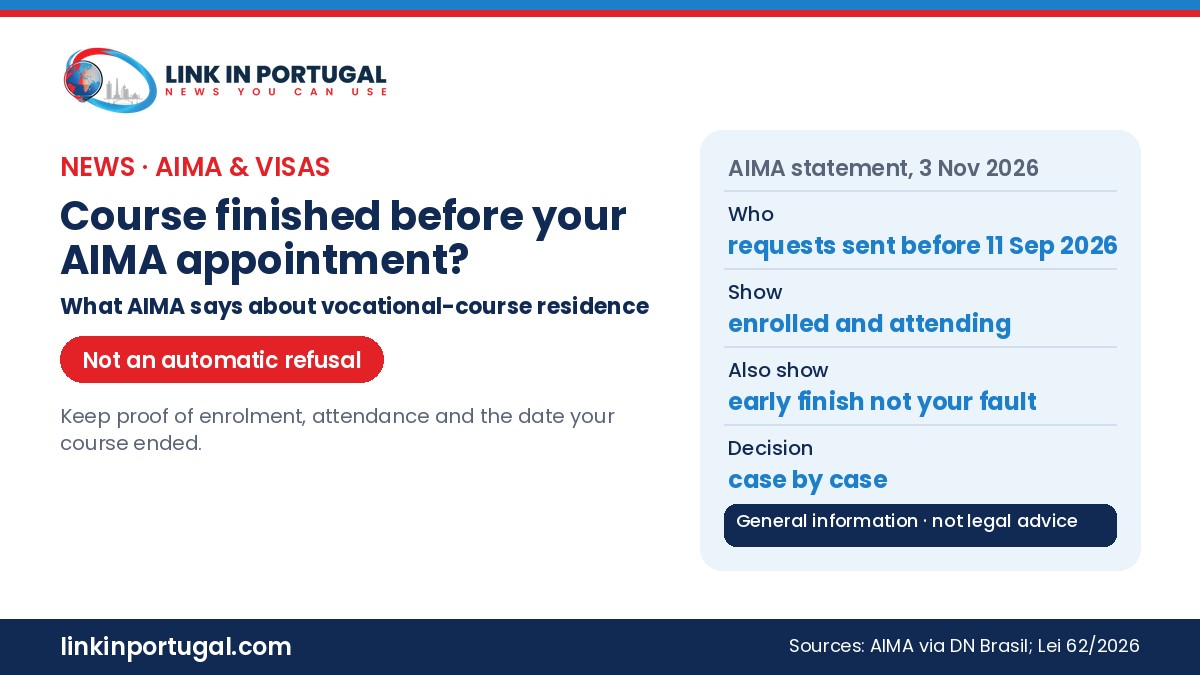
Not the requirements. Law 61/2025 changed other articles (visas, family reunification, CPLP permits and more), not articles 76, 80 or 125 to 131. Law 62/2026, in force since 11 September 2026, changed the procedure rules: AIMA must decide a new permit within 90 days (extendable by 30), and tacit approval was removed (article 82). It also revoked one paragraph on procedural guarantees for EU long-term residents (article 132(2)). Article 80 itself was not changed.
Why permanent residence matters more now
Under Organic Law 1/2026, citizenship by naturalisation now needs 7 years of legal residence for nationals of Portuguese-speaking countries and EU citizens, and 10 years for others. That leaves a long gap after year five. Permanent residence gives you a status that no longer depends on a specific job or purpose, a card you renew only every five years, and more stability for loans, rentals and family plans.
| Permanent residence | Citizenship | |
|---|---|---|
| Time needed | 5 years with temporary permits | 7 years (CPLP and EU) or 10 years (others) |
| Passport | You keep your own | Portuguese (EU) passport |
| Vote in national elections | No | Yes |
| Can be lost | Yes, for example after long absences | Only in rare cases |
FAQ
Can I apply after 5 years if I spent some time abroad?
For permanent residence, the law asks for five years as the holder of a temporary permit. Long absences can lead to a temporary permit being cancelled (6 months in a row or 8 months in total during its validity, without good reason), so check your travel history with a lawyer before you apply.
Is A2 enough for permanent residence?
The law says “basic Portuguese”. AIMA’s list of accepted proofs includes A2 or higher from a PLA course and a CAPLE test certificate.
Do I apply online?
AIMA’s page says permanent residence is requested by appointment at a Loja AIMA, in person. We did not find an online option for it.
How long is the permanent residence card valid?
The permit has no end date, but the card must be renewed every five years.
Want a professional to check your case?
For advice on your own situation, speak to a certified accountant (contabilista certificado), a lawyer, or the official service. Questions or corrections about this guide? Contact Link in Portugal.
Official sources
- Foreigners Law (Lei 23/2007), consolidated (PGDL) – articles 76, 78, 80, 85 and 125–126
- Foreigners Law (Lei 23/2007), consolidated (PGDL) – articles 128–131
- AIMA – Autorização de residência permanente (art. 80.º)
- Diário da República – Law 61/2025
- Diário da República – Law 62/2026
- Diário da República – Organic Law 1/2026 (nationality)
- AIMA – Contacts
This guide is general information, checked against official sources on 5 October 2026. Rules and portals in Portugal change often, so confirm the current rules with the official source before you act. It is not legal advice.

2 thoughts on “Permanent Residence in Portugal After 5 Years (2026)”