Portugal’s Ombudsman (Provedoria de Justiça), acting as the National Prevention Mechanism (MNP), found that some Public Security Police (PSP) officers wrongly treated a simple overstay as a crime, and recommended that the PSP issue internal guidance to correct this. The MNP’s report says the PSP issued a technical rule in April 2026; the PSP told Diário de Notícias it has also trained officers. Here is what the law says, as amended by Law 62/2026, if your papers have expired.
What happened
The finding is in the MNP’s 2025 report (section 4.8.3). In contacts with officers at several police stations, the MNP found the mistaken belief that merely entering or staying in Portugal irregularly is a crime, because it can lead to detention. The MNP warned that this misunderstanding can also lead to inappropriate and disproportionate measures when people are detained, such as how they are transported and the use of handcuffs, and can reinforce the stigmatisation of migrants. Diário de Notícias (DN) reported the finding on 1 October 2026, and Jornal de Notícias (JN) followed on the evening of 2 October.
The Provedoria’s 2025 Activity and MNP reports went to Parliament on 23 September 2026. The official note says the MNP stepped up its monitoring of how the security forces handle foreign nationals’ entry and stay, and of police facilities, including detention conditions. The MNP report says the problem was particularly worrying in the specialised team of the PSP’s Beja unit. According to DN, the PSP said the Beja unit and other officers of that command were trained in early 2026; that its foreigners and borders unit (UNEF) holds regular online meetings with all its units, the latest on 28 September, where it again asked them to brief officers not yet trained; and that more than 500 officers have had this training so far. These details come from the PSP’s answers to DN; we found no PSP or Provedoria publication confirming them.
What the law says
Under the Foreigners Law (Law 23/2007, article 192, still current after Law 62/2026), staying beyond the authorised period is an administrative offence (contraordenação), not a crime. Fines: €80–€160 (up to 30 days), €160–€320 (to 90 days), €320–€500 (to 180 days), €500–€700 (over 180 days). The same fine can apply if the overstay is found when you leave (article 192(2)).
The MNP report, quoted by DN and JN, says that only failing to obey a notice to leave Portugal immediately amounted to the crime of qualified disobedience (desobediência qualificada) and justified an arrest. It cites article 138(4) of the Foreigners Law. That rule no longer exists: Law 62/2026, in force since 11 September 2026, revoked article 138(4), so the Foreigners Law no longer makes ignoring such a notice a crime. A plain irregular stay is still the administrative offence above, and it is also a ground for coercive removal (article 134). Under article 146, police can detain a person who entered or stays irregularly, who must be brought before a judge within 48 hours; the MNP stresses that this detention is not linked to a crime. After a decision refusing your application or cancelling your visa or permit, the current article 138 gives you 20 to 30 days to leave; the PSP can extend this, taking into account how long you have been here, children at school, and family and social ties. If you do not leave within the deadline set in a removal or expulsion decision, article 161 says you are detained and taken to the border. What remains a crime for the foreign national under this law includes entering Portugal while banned from entry (article 187: up to two years in prison or a fine of up to 100 days) and a marriage or partnership of convenience to obtain a visa or permit (article 186). Read any notice carefully and get legal advice before you ignore it.
What the PSP changed
The MNP report says that in April 2026 the PSP issued a technical rule standardising procedures, which expressly states that detention linked to an irregular stay is administrative and serves coercive removal proceedings. The MNP calls this a positive development. It also found that the code for these cases in the PSP’s computer system matched codes used for immigration crimes, and recommended a specific code whose name shows that an irregular stay is only an administrative offence. On handcuffs, it recommended clear instructions that they should be avoided when there is nothing concrete to justify them, especially when the person is not suspected of a crime. The MNP also found PSP posts, including on social media, that wrongly called an irregular stay a crime. According to DN, the PSP said its external communications staff have been told about this and that it must be corrected, and that some of the irregular cases it detected were real crimes because the people had breached a Schengen entry ban.
What this means for you
- Expired card or visa ≠ automatic “criminal.” Overstay is usually a fine under article 192 — but still not risk-free.
- You can still be fined, ordered to leave, or put in a removal process when the law allows. Fix your status; this is not a free pass.
- If police stop you, stay calm and show your ID and any AIMA receipts or approval proof. If you are held in a temporary detention centre or similar facility, article 146-A lets you contact your family, your consulate and your legal representatives, and speak to your lawyer in private.
- If you receive a written decision or notice to leave, do not ignore it. Since Law 62/2026, missing the deadline is no longer qualified disobedience under the Foreigners Law, but you can be detained and removed (article 161). A removal decision bans you from entering Portugal for up to five years, or longer in serious cases (article 144), and entering during a ban is a crime (article 187). You can challenge a PSP removal decision in the administrative courts and ask for legal aid (article 150).
What to do now
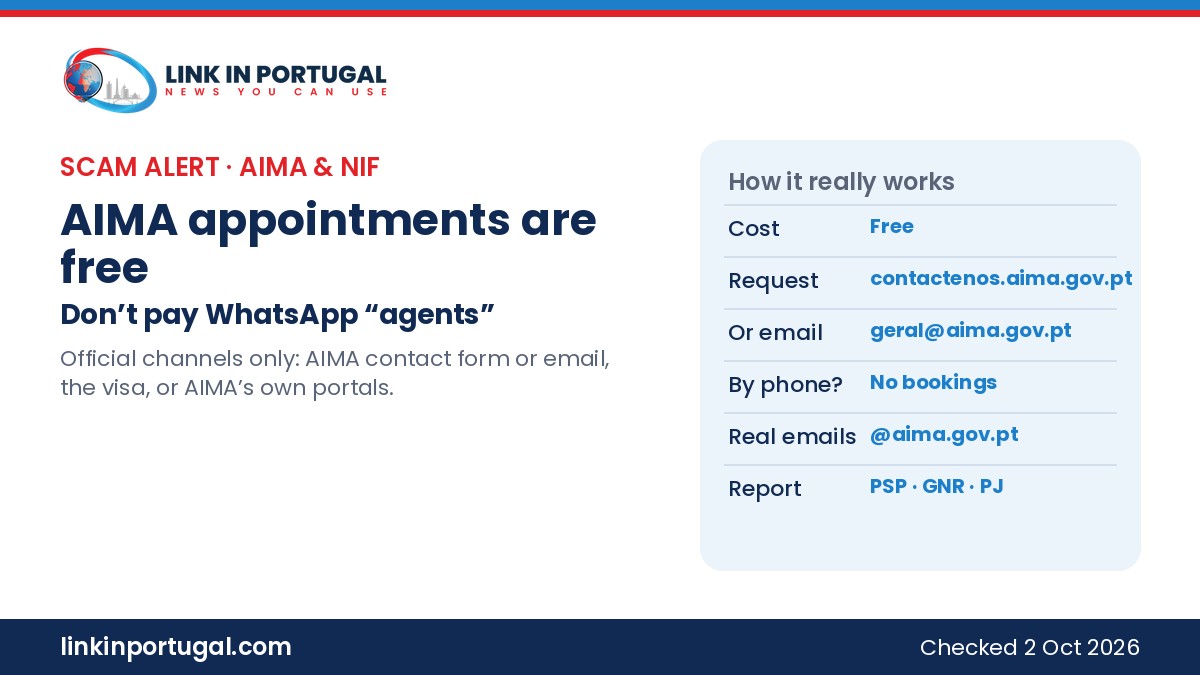
- Check whether you can renew or apply through AIMA’s Portal de Renovações or other official channels on aima.gov.pt — not paid WhatsApp “agents”.
- Keep passport, old card, AIMA receipts, emails and any approval proof together.
- For case questions, write to AIMA through its contact form or call the Contact Centre on (+351) 217 115 000. AIMA’s contacts page gives Monday to Friday, 08:00–20:00; the panel on the contact form gives weekdays 09:00–18:00 for the same number.
- For legal advice, contact a lawyer. For information and support, for example on regularising your status, you can go to a Local Support Centre for Migrant Integration (CLAIM; AIMA’s contacts page links to the network). To complain about how a public authority, including the police, treated you, contact the Provedoria (provedor-jus.pt).
Key dates
- April 2026 — PSP technical rule on detention for irregular stay (MNP 2025 report).
- 11 September 2026 — Law 62/2026 in force; it revokes article 138(4) of the Foreigners Law (the immediate-departure notice “under penalty of” qualified disobedience).
- 23 September 2026 — Provedoria delivers 2025 Activity + MNP reports to Parliament.
- 28 September 2026 — Latest UNEF online meeting with PSP units on this issue (the PSP, according to DN).
- 1–2 October 2026 — Press coverage (DN, JN, SAPO, Executive Digest).
This explains the legal category of overstay and the Provedoria–PSP clarification of early October 2026. Not legal advice for your case.
Last updated: 3 October 2026. We corrected the section on when not leaving can be a crime: Law 62/2026 revoked the rule on qualified disobedience that the MNP report cites.
Featured image: Branded graphic: Link in Portugal (no third-party news photos)