

Last checked: 5 October 2026 · By Link in Portugal
Housing is one of the hardest parts of moving to Portugal, especially in Lisbon, Porto and the Algarve. This guide explains what a landlord can legally ask you to pay before you move in, what a fiador (guarantor) is, how the contract and rent receipts work with Finanças, and why all of this matters later for your IRS and your AIMA file.
This is general information, not legal advice. Rental law is changing: a reform passed its first vote in Parliament on 30 September 2026 but is not law yet. Everything below is the law in force on 5 October 2026. For a dispute, speak to a lawyer or solicitor, or a tenants’ association.
At a glance
| Question | Short answer (law in force) |
|---|---|
| Maximum deposit (caução) | The value of 2 months’ rent |
| Maximum rent paid in advance | 2 months, and only with a written agreement |
| Is a fiador required by law? | No. It is a condition some landlords set |
| Who tells Finanças about the contract? | The landlord, by the end of the month after it starts |
| Rent receipts | Electronic receipts on Portal das Finanças, unless the landlord is exempt |
| Maximum yearly update for 2027 | Coefficient 1.0256 (2.56%), if the contract follows the legal update rule |
What a landlord can legally ask for: deposit and advance rent
Article 1076 of the Civil Code sets two limits. You can read the current wording in the consolidated Civil Code; it was changed by the 2023 State Budget law, Lei n.º 24-D/2022.
- Advance rent: rent can be paid in advance, with a written agreement, for a period of no more than two months.
- Deposit (caução): the parties can guarantee their obligations in any legally allowed form, up to the value of two months’ rent.
So a typical legal move-in cost is the first month’s rent plus, at most, two months in advance and a deposit of up to two months. If a landlord asks for six months up front, that is above what the Civil Code allows. You can say no, or ask a lawyer before you sign.
Fiador: what it is and whether you need one
A fiador is a person, usually a Portuguese resident with a stable income, who signs the contract and promises to pay if you don’t. Many landlords ask newcomers for one because you have no Portuguese credit history yet.
No law says every tenant must have a fiador. It is a condition the landlord can set when choosing a tenant. If you can’t offer one, landlords sometimes accept other options, such as a bank guarantee, a work contract and recent payslips, or proof of savings. These are negotiated case by case.
The two-rent limit in article 1076 is written for guarantees given “in any legally allowed form”. How it applies when a fiador is combined with a deposit is a legal question we have not seen settled in an official source, so ask a lawyer if a landlord asks for a lot of guarantees at once.
The written contract and Finanças
Always get a written contract that names the landlord and their NIF, the property, the rent, the start date and length, and the deposit. It is your main proof if anything goes wrong.
The landlord must tell the Tax Authority about the contract. According to the Portal das Finanças FAQ, contracts, their changes and their end must be communicated by the end of the month after the lease starts, changes or ends. This is done with the Stamp Duty form Modelo 2, which is filed by the landlord (AT instructions).
You can ask the landlord for proof that the contract was communicated. A lease that Finanças knows about protects you and lets you use it as proof of address.
Electronic rent receipts
Landlords normally have to issue electronic rent receipts on Portal das Finanças each time you pay. According to the AT leaflet on Modelo 44, a landlord is only exempt if, at the same time, they don’t have (and aren’t required to have) an electronic tax mailbox and their rental income stays below a low yearly limit (twice the IAS). Exempt landlords who don’t issue electronic receipts declare the rents once a year on Modelo 44.
Why this matters to you: receipts that reach Finanças are an official record of the rent you paid, which you need for the rent deduction in your IRS return, and they are strong proof that you really live at that address. We haven’t re-checked the 2026 deduction amount, so confirm it on Portal das Finanças.
Your lease and AIMA
AIMA checks housing. For a renewal, the Foreigners Law (article 78) says the permit is only renewed if you have accommodation. For permanent residence, AIMA’s own page asks tenants for a declaration of address and a statement from the landlord explaining the legal basis for living there.
If you live in a room without a contract in your name, an atestado de residência from your Junta de Freguesia can help, but a registered lease is stronger. Keep your address updated at Finanças, Social Security and AIMA, and at your bank (see opening a bank account).
Rent increases in 2027
Under article 1077 of the Civil Code, the contract can set its own update rule. If it doesn’t, the rent can be updated once a year using the official coefficient, and the landlord must tell you in writing at least 30 days before. The first update can only happen one year after the contract starts.
For 2027 the coefficient is 1.0256 (a 2.56% increase), published by INE in Aviso n.º 24199/2026/2 in the Diário da República on 1 October 2026. Example: a rent of €800 could go up to about €820.48 a month.
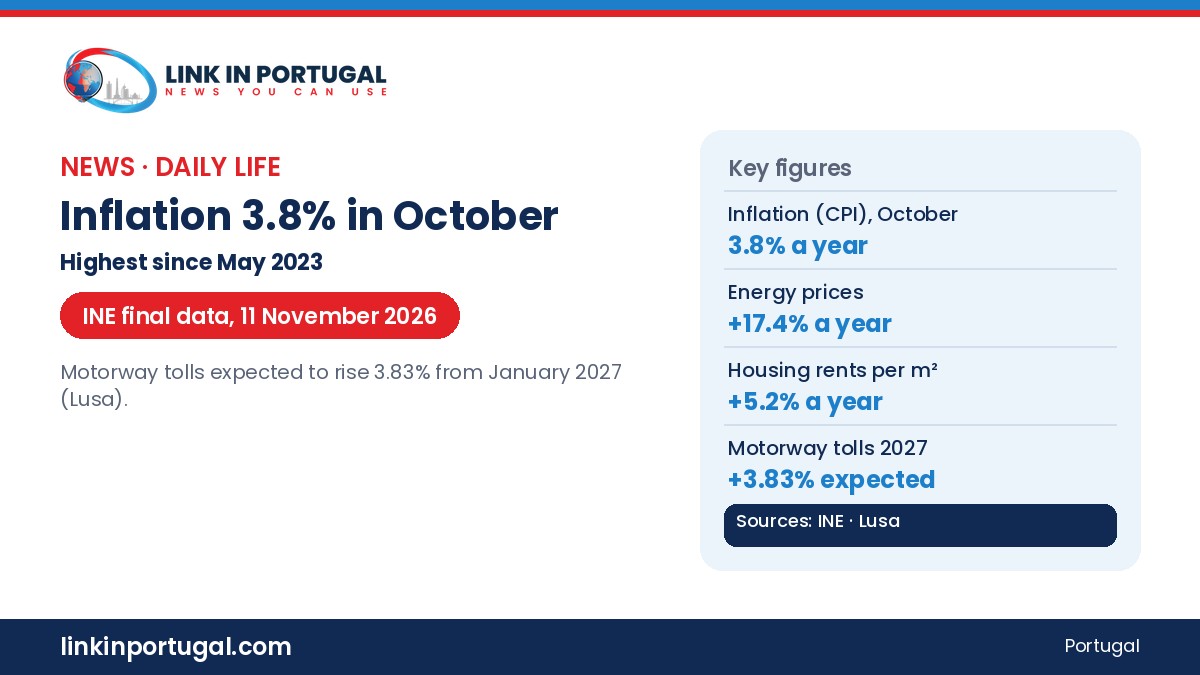
New contracts are a different story: market rents for new leases rose 10.2% in a year, according to INE figures we covered in our report on Q2 2026 rents. Also read what the reform proposal would change.
Rental scams aimed at newcomers
- Never pay a deposit for a flat you haven’t seen, in person or on a live video call with someone you can verify.
- Be suspicious of prices far below the market, and of landlords who are “abroad” and want money first.
- Check who owns the property. The land registry certificate (certidão permanente) shows the owner.
- Pay by bank transfer to an account in the landlord’s name, and keep every receipt and message.
- Don’t send copies of your passport or residence card to people you haven’t verified.
Help with rent
Young people can apply for the Porta 65 Jovem rent support programme, and there are other national and municipal supports. Check eligibility and dates on the Portal da Habitação (IHRU).
FAQ
Can my landlord ask for 3 months’ deposit?
Not under the law in force on 5 October 2026. Article 1076 limits guarantees to the value of two months’ rent and advance rent to two months. The reform being discussed in Parliament could change this, but it is not law yet.
Do I need a fiador to rent in Portugal?
The law doesn’t require one. A landlord can ask for one as a condition, and you can offer alternatives such as a bank guarantee or proof of income.
My landlord won’t register the contract or give receipts. What can I do?
Registering the contract and issuing receipts are the landlord’s tax duties. Ask in writing first and keep the reply. If nothing changes, get advice from a lawyer or a tenants’ association. You can also ask for help with the tax side.
Will my rent go up in 2027?
If your contract follows the legal update rule, the maximum yearly update for 2027 is 2.56%, and the landlord must tell you in writing at least 30 days before.
Want a professional to check your case?
For advice on your own situation, speak to a certified accountant (contabilista certificado), a lawyer, or the official service. Questions or corrections about this guide? Contact Link in Portugal.
Official sources
- Civil Code, consolidated (PGDL) – articles 1076 and 1077
- Diário da República – Lei n.º 24-D/2022 (State Budget 2023, changed article 1076)
- Portal das Finanças – FAQ: communication of rental contracts
- Portal das Finanças – Modelo 2 (Stamp Duty) instructions
- Portal das Finanças – Modelo 44 and the e-receipt exemption
- Diário da República – Aviso n.º 24199/2026/2 (2027 coefficient 1.0256)
- Foreigners Law (Lei 23/2007), consolidated (PGDL) – article 78
- AIMA – Permanent residence (art. 80): address documents
- Portal da Habitação (IHRU) – Porta 65 Jovem
This guide is general information, checked against official sources on 5 October 2026. Rules and portals in Portugal change often, so confirm the current rules with the official source before you act. It is not legal advice.


3 thoughts on “Renting in Portugal 2026: Deposit, Fiador and Contract”