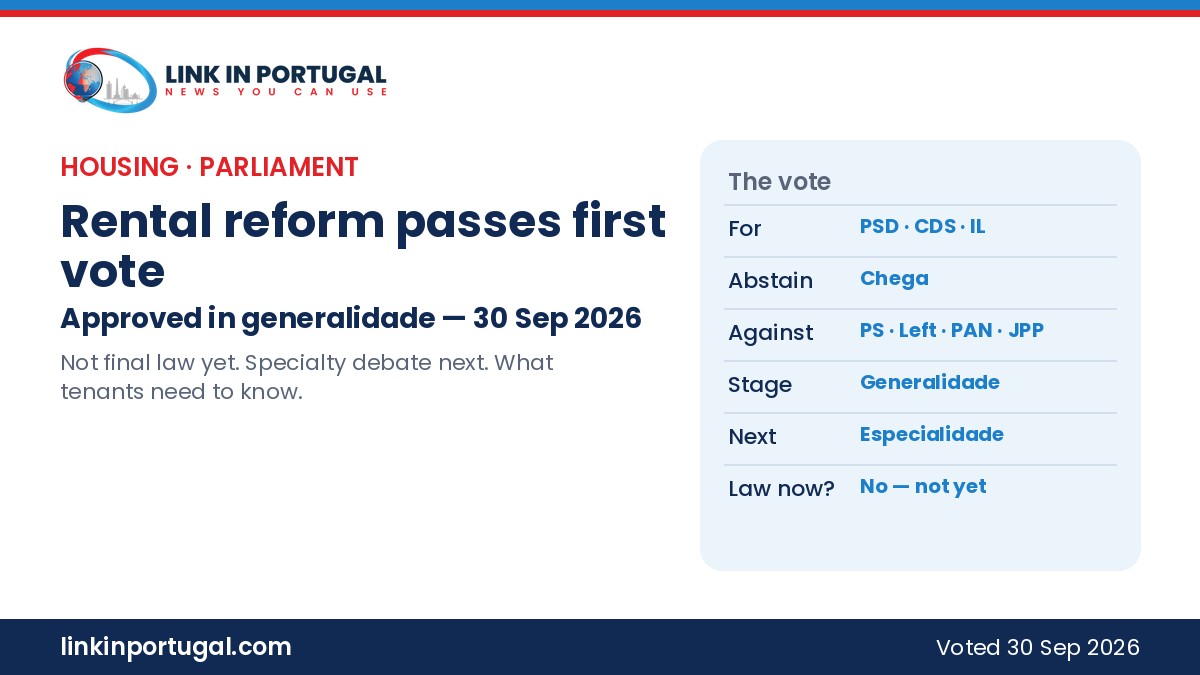
On Wednesday, 30 September 2026, Portugal’s Parliament approved in generalidade the government’s bill to rewrite urban rental rules. This is the first reading — not the final law. Here is the vote, what still has to happen, and what it means if you rent.
How the vote went
Lusa-based reports (JN, Executive Digest, RTP; Jornal Económico on 1 October) say the proposal passed in generalidade with:
- For: PSD, CDS-PP and Iniciativa Liberal
- Abstention: Chega (this let the bill move forward)
- Against: PS, Livre, PCP, Bloco de Esquerda, PAN and JPP
Other parties’ bills on the same theme were all rejected. Reuters also confirmed first-reading approval the same evening.
PSD–Chega deal before the vote
Minutes before the vote, PSD parliamentary leader Hugo Soares and Chega leader André Ventura signed an agreement (quoted by Lusa) committing the PSD to push four changes in committee (especialidade):
- Limit advance payments and deposits relative to what the government originally proposed
- Protect older, low-income tenants on pre-1990 contracts, with a landlord compensation regime
- Strengthen the social response for tenants and reinforce the emergency housing fund
- Clearly separate wilful, repeated non-payment from real inability to pay after extraordinary rent rises
Those are political commitments for committee — not yet published law.
What the government draft still aims to do
Until specialty locks the text, treat this as proposal direction (see our preview), not rules in force:
- Unpaid rent: grounds to end a lease after two months unpaid (today: three)
- Repeated late payment: more than eight days late more than a set number of times in 12 months could also justify ending the lease
- Move-in cash: written agreement for up to three months rent in advance; no fixed legal cap on the deposit (caução) in the original draft — this is one area Chega wanted limited
- New contracts: freer starting rents / updates than under recent Mais Habitação-style caps (Reuters: ending a 2% increase cap for certain recently re-let homes)
Executive Digest/Lusa also notes the draft would simplify eviction procedure by cutting a second enforcement track after a favourable court decision.
What this means for immigrants who rent
Your current contract does not change tonight. Generalidade is step one. Specialty debate, a final global vote, and publication (plus decree-law if this stays a legislative authorisation) still lie ahead. Until a final text appears in the Diário da República and applies to you, today’s NRAU rules stay in force.
If you are house-hunting, budget for higher move-in cash (advances + deposit) if specialty keeps those tools. If you already rent, freer new-lease pricing matters most when you renew or move. Faster legal grounds are not the same as being put on the street the next day — contested cases still go through courts.
What to do now
- Do not panic-move because of the first vote alone.
- Keep proof: signed contract, rent receipts, bank transfers, and written messages with the landlord.
- Pay on time if you can — the draft shortens the unpaid-rent window from three months to two.
- House-hunting? Get every advance and deposit in writing before you transfer money; never pay an unverified “reservation” deposit.
- Watch the specialty stage — deposits, advances and social safeguards may still change under the PSD–Chega deal.
Key dates
- 30 September 2026 — approved in generalidade
- Next — discussion and vote in especialidade, then final global vote
- Later — decree-law / publication in Diário da República before rules apply
Sources
- JN – Proposta do Governo para arrendamento aprovada com abstenção do Chega (30 Sep 2026, 20:57)
- Executive Digest/Lusa – Aprovada na generalidade (30 Sep 2026, 21:08)
- RTP – Parlamento aprova nova lei do arrendamento com abstenção do Chega
- Jornal Económico – Aprovada na generalidade após acordo PSD–Chega (1 Oct 2026)
- Reuters via MarketScreener – Parliament backs swifter evictions, end of rent caps (30 Sep 2026)
- Link in Portugal – Preview before the vote (29 Sep 2026)
This guide is general information, not legal advice. Rules change often; check the final published text and, if needed, a lawyer or tenants’ association before acting. Last updated: 1 October 2026.
Featured image: Branded graphic: Link in Portugal (no third-party news photos)