On Thursday, 1 October 2026, Portugal’s revised building and urbanisation rules — the RJUE reform in Decree-Law 108/2026 — entered into force. If you are buying a home, renovating, or waiting on a municipal file, this is the practical change that matters today. It is separate from the rental reform still going through Parliament.
What took effect today
The government published the RJUE rewrite on 29 May 2026. Entry into force was postponed by Decree-Law 155-B/2026 (31 July) from early August to 1 October 2026 so councils and IT systems could adapt. Matching application forms are in Ordinance 320/2026/1 (31 July).
Municipal FAQs (for example Amadora’s DL 108/2026 summary) say the reform applies to procedures started on or after 1 October, and to older files that were still in early saneamento / liminar screening on that date.
If you are buying: the urbanistic-title mention
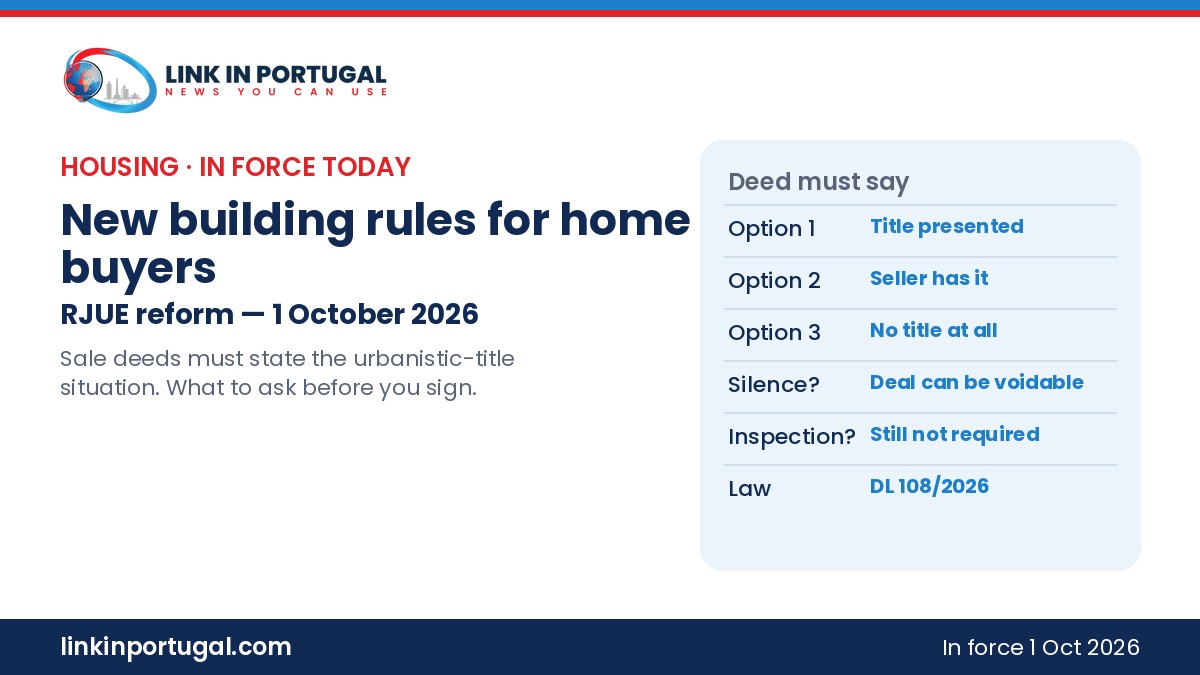
For many immigrants the headline change is what must appear in the sale deed or other transfer document for urban buildings, building plots and autonomous fractions.
Under the new RJUE text (article 4.º-A, n.º 14, as summarised in Amadora’s FAQ and buyer guides citing DL 108/2026), the professional who titles the deal must record one of these:
- the urbanistic title was presented; or
- the seller declares they have the title but does not show it; or
- the seller declares they do not have any urbanistic title.
Leaving that mention out can make the deal anulável (voidable). Selling without a title remains legal if that absence is declared. Declaring is not a municipal inspection: the deed still does not require anyone to check that the building matches the licensed plans.
Ask before CPCV or deed day: which procedure was used, which papers make up the title, and which of the three declarations the seller will make. If they will say “no title”, treat that as a negotiation point — not a surprise at the notary.
If you are building or renovating
Where urbanistic parameters are already fixed (detailed plan, execution unit, loteamento, or many consolidated urban zones), comunicação prévia is the main track: submit, pay fees, notify the start of works — without waiting for an old-style prior municipal “yes”. Control shifts more to after the start, while inspection powers remain.
True reconstruction to the last valid form of the building can be exempt from licence and prior communication when it meets the legal definition (no increase in area, volume or height). Licensing deadlines for more complex cases are shortened (municipal FAQs cite final decision windows such as 20 days for many building/demolition licences, 30 for urbanisation works and 45 for loteamentos).
Transition friction
Executive Digest (1 October, citing Jornal de Negócios) reports the Ordem dos Arquitetos warning that some municipal platforms are still adapting and that the nationwide electronic licensing platform is not yet fully operational. Expect uneven local practice in the first weeks — confirm with your municipality or technician before you rely on a deadline.
What this is not
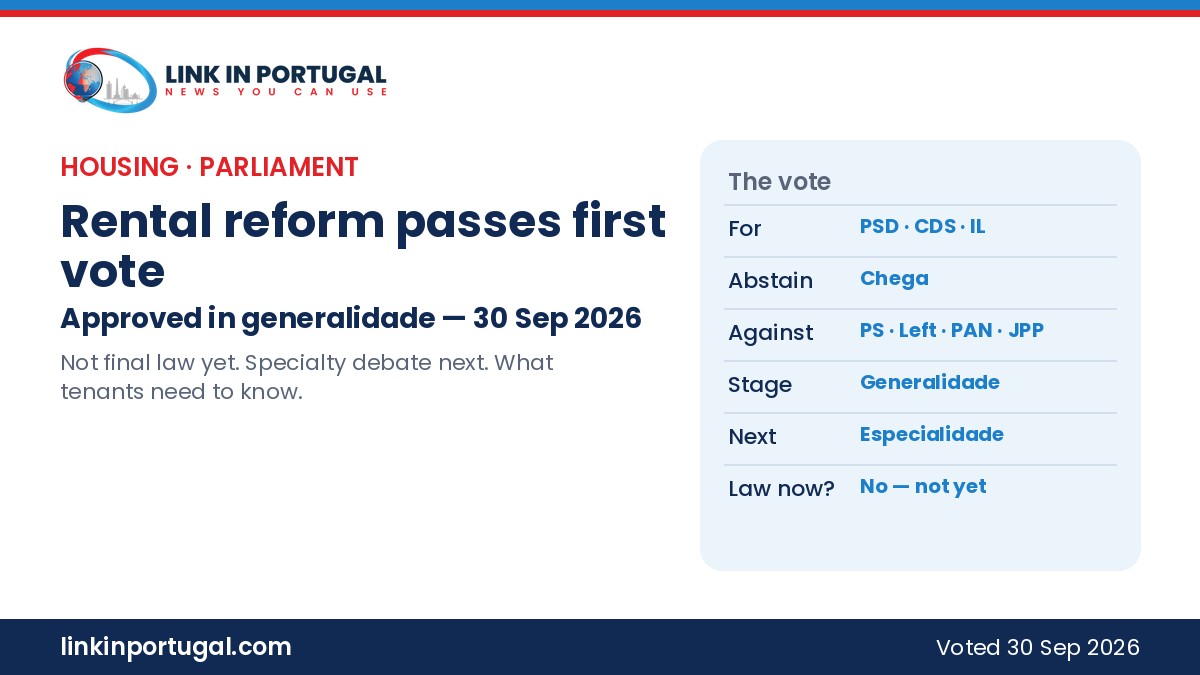
This is not the rental-law package that passed first reading on 30 September (still heading to specialty). RJUE is about building control and sale transparency. It does not restore a municipal legality check inside the deed.
What to do this week
- Buyers: put the urbanistic-title questions in writing before you sign; consider a private technical check if the property has extensions or old works.
- Pending files: ask whether your case was still in liminar screening on 1 October and which rules now apply.
- Works: use the Portaria 320/2026/1 models; do not start without the required start-of-works communication where the law demands it.
- Renters only: no immediate change from RJUE — watch the separate rental bill in specialty.
Practical news, not legal advice. For a specific purchase or licence, use a lawyer/notary and a qualified technician, and the consolidated RJUE text in the Diário da República.
Featured image: Branded graphic: Link in Portugal (no third-party news photos)