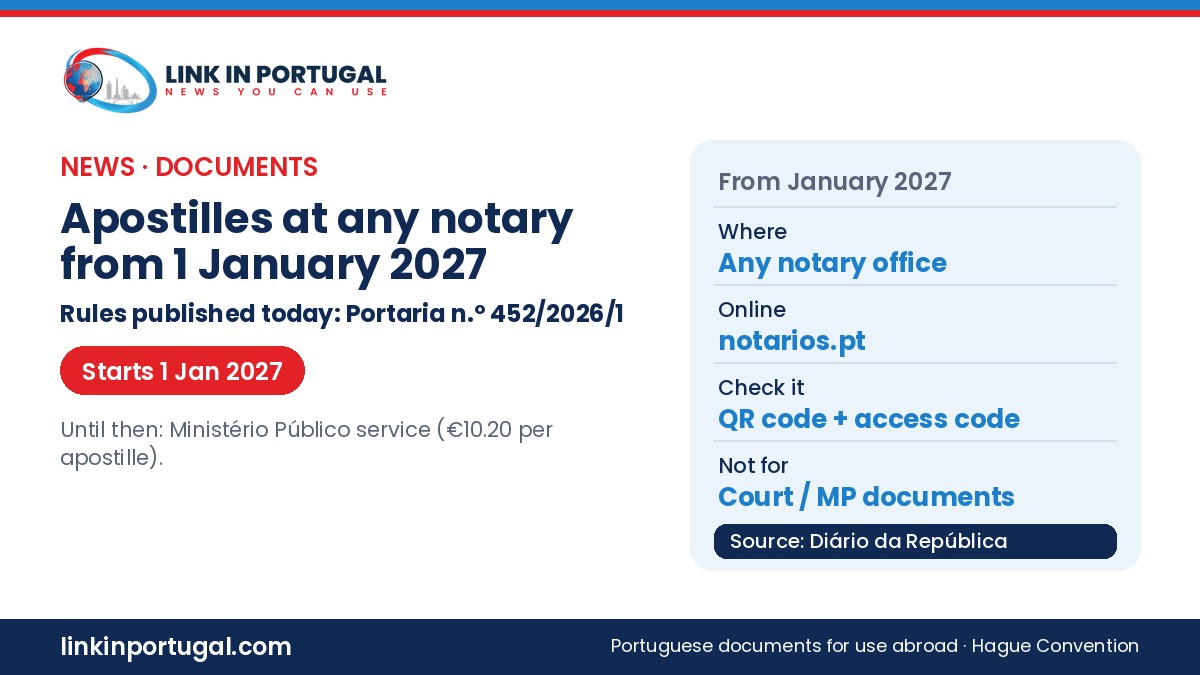
The rules that let notaries issue apostilles on Portuguese public documents were published today in the Diário da República. Portaria n.º 452/2026/1 (Série I, 12 October 2026) enters into force on 13 October but only takes effect on 1 January 2027. Until then, nothing changes: apostilles are still issued by the Ministério Público.
Law status: published 12 October 2026; in force from 13 October 2026; applies from 1 January 2027.
What is an apostille?
An apostille is a certificate under the 1961 Hague Convention. It confirms that the signature, the signer’s role and the stamp or seal on a Portuguese public document are genuine, so the document can be used in another member country without embassy legalisation. You may need one to send abroad, for example, a birth certificate for a child born in Portugal, a marriage certificate, a Portuguese school or university certificate, or a document from a câmara municipal, junta de freguesia or registry office.
What changes from 1 January 2027
- Any notary office: you, or anyone holding the document, can ask for an apostille in person at any cartório notarial, or online at notarios.pt, the Ordem dos Notários platform (article 5).
- Not for court documents: notaries cannot apostille documents issued by the courts or the Ministério Público (article 3).
- Paper or digital: for a paper document, the apostille is printed, signed, stapled to it and sealed. For a digital document, you get one signed PDF. On request, a notary can scan a paper document to issue a digital apostille (article 6).
- QR code check: every apostille gets a QR code and an access code. Anyone can check it is genuine on notarios.pt (article 6).
- Cost: you pay the notary office directly. The notary may charge fees under the notary fee rules (Portaria n.º 385/2004, article 14), plus VAT. The new portaria does not set a euro amount (article 10).
How it works today
According to the Ministério Público apostille page, apostilles are issued by the Procuradoria-Geral da República in Lisbon and, by delegation, in Porto, Coimbra, Évora, Guimarães, the Azores and Madeira. The fee is €10.20 per apostille. It is free if you prove economic hardship with an official document. In-person service is by appointment (e-APP). Digital documents are apostilled online at apostila.ministeriopublico.pt. The new portaria adds notaries. It does not say the Ministério Público service will close.
The Justice Minister announced the change at the notaries’ congress on 9 October, as reported by the Ordem dos Notários and ECO (9 October 2026).
For readers from Pakistan, India, Bangladesh and Nepal
An apostille only replaces embassy legalisation if the country where you will use the document is in the Convention. The HCCH status table lists India (since 2005), Pakistan (since 9 March 2023) and Bangladesh (since 30 March 2025). Nepal is not listed, so Portuguese documents for Nepal still need legalisation. Before you pay, ask the office that will receive your document whether it accepts a Portuguese apostille.
Bringing documents from your home country to Portugal works the other way round. Those are apostilled or legalised in the country that issued them, not by a Portuguese notary. Registering a new baby? Read how to get a NISS for a baby born in Portugal.
What to do
- Need an apostille before January? Use the Ministério Público service now. Do not wait for notaries.
- From January, ask your notary for the price first, as fees can differ.
- Keep the code printed on your apostille so the receiving office can check it.
- An apostille confirms the signature and seal only. It does not translate the document. Ask whether a translation is also needed.
Key dates
- 8 October 2026: portaria signed by the Secretary of State for Justice.
- 12 October 2026: published in the Diário da República.
- 1 January 2027: notaries can start issuing apostilles.
Sources
- Diário da República – Portaria n.º 452/2026/1, 12 October 2026 (official)
- Ministério Público – Apostille service, fee and offices (official)
- HCCH – Apostille Convention status table (official)
- Ordem dos Notários – Minister announces signing of the portaria (9 October 2026)
- ECO – Apostille available at notaries from January (9 October 2026)
Featured image: Branded graphic: Link in Portugal (original work; no third-party photos)
This article is general information, not legal advice. Rules change often; check with the Ministério Público, your notary or the authority that will receive your document before you act. Link in Portugal is not affiliated with the Ordem dos Notários, the Ministério Público or the Portuguese Government. Last updated: 12 October 2026.