
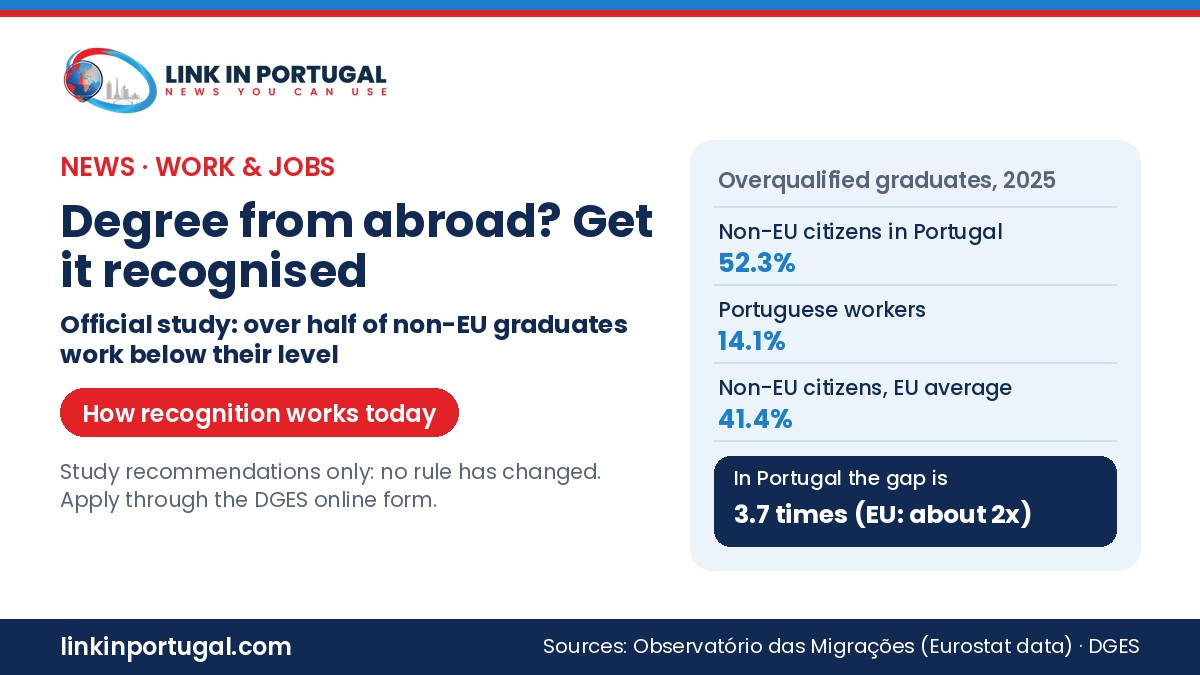
More than half of non-EU graduates working in Portugal have jobs below their level of education. That is the main finding of a new study, “Emprego de imigrantes: Portugal no contexto europeu”, published on 9 October 2026 by the Observatório das Migrações (OM), the official migration observatory that now sits within AIMA. The study makes recommendations only: no rule has changed. Here is what it found and how you can get a foreign degree recognised today.
What the study found
According to the study (PDF, in Portuguese), using Eurostat data for 2025:
- 52.3% of non-EU citizens with a higher-education degree were overqualified for their jobs, against 14.1% of Portuguese workers: 3.7 times more. Across the EU the gap is about 2 to 1 (41.4% against 20.0%). Eurostat marks the 2025 figure for Portugal as having low reliability because the sample is small.
- 33.7% of foreign employees had a temporary contract, against 13.3% of Portuguese employees (about 2.5 times more).
- 17.8% of employed foreigners were at risk of in-work poverty, against 8.0% of Portuguese workers.
- Finding work is not the main problem: 75.6% of residents born outside the EU had a job, slightly more than people born in Portugal (73.4%).
Diário de Notícias reports that red tape and slow degree recognition are the main reason. The study’s first recommendation is to simplify and shorten degree recognition and access to regulated professions, especially in health, engineering and teaching. It also suggests short training courses, skills certification and work-related Portuguese classes. These are recommendations for public policy, not new rules.
How degree recognition works today (official)
Under Decree-Law 66/2018 (as amended), in force, there are three types of recognition, all with the same legal value, according to the DGES (Direção-Geral do Ensino Superior) recognition page. You apply for all of them through the DGES online form, choosing who will assess your request:
- Automatic recognition: only for degrees on an official list. DGES or a public university can decide. DGES lists a fee of €32.20 and a decision within 30 working days of a complete application.
- Level recognition: a public university or polytechnic confirms that your degree matches a Portuguese level (licenciatura, mestrado or doutoramento). The institution sets the fee; up to 90 working days.
- Specific recognition: a public institution compares your course in detail and recognises it in one field, for example nursing. The institution sets the fee; up to 90 working days.
You need proof of the degree, such as a copy of the diploma authenticated by the competent authorities; level and specific recognition may also ask for transcripts. Documents in English, French or Spanish do not need translating; other languages may need a certified translation (DGES FAQ). See our guide to legalising or apostilling your documents.
Regulated professions: ask the professional body
For most jobs, the employer decides what qualifications it accepts. For regulated professions you also need the authority that controls the profession. The Ordem dos Enfermeiros requires specific recognition for nurses with a foreign degree. The Ordem dos Engenheiros accepts foreign engineering degrees recognised at the right level. For teaching, DGES points to DGAE. Check whether your job is regulated in the EU database of regulated professions.
What you can do now
- Get your diploma and transcripts authenticated (apostille or legalisation, depending on the country) before you apply.
- Check the current fee with the institution you choose before you pay, and keep your application number.
- Learn Portuguese: IEFP’s Português Língua de Acolhimento courses are for migrants aged 16 or over (conditions apply), 75 hours per level (up to 100 for non-Latin alphabets). Pre-register on iefponline.
- Certify work skills: a Centro Qualifica can certify skills from work experience (RVCC Profissional).
- Looking for a better job? See where to find jobs and your rights as a worker.
Sources
- Observatório das Migrações – Emprego de imigrantes: Portugal no contexto europeu (9 October 2026) and the full brief paper (PDF)
- Diário de Notícias (DN Brasil) – More than 50% of immigrants are in jobs below their qualifications (10 October 2026)
- DGES – Recognition of foreign higher-education degrees and diplomas and DGES recognition FAQ
- Diário da República – Decree-Law 66/2018
- Ordem dos Enfermeiros – Guidance on recognition of foreign degrees (PDF, March 2025)
Featured image: Branded graphic: Link in Portugal (original work; no third-party photos)
This article is general information, not legal advice. Fees and processing times can change: check the DGES page and the institution or professional body before you apply. Link in Portugal is not affiliated with AIMA, the Observatório das Migrações, DGES or any professional body. Last updated: 10 October 2026.


One thought on “Over Half of Non-EU Graduates in Portugal Work Below Their Level: How to Get Your Degree Recognised”