
Last checked: 5 October 2026 · By Link in Portugal
Family reunification (reagrupamento familiar) lets a foreign resident bring close relatives to live with them in Portugal. The rules became stricter on 23 October 2025, when Law 61/2025 came into force. This guide explains the waiting time, who is exempt, which documents AIMA asks for and how to start the request.
Update (1 November 2026): DN Brasil reported on 31 October 2026, citing AIMA sources, that the transition option stayed open until late October and has now ended; AIMA has not published an official notice. DN Brasil also reports that AIMA is preparing a single new portal for family reunification requests. Read our news story: AIMA family reunification: transition option ends, new single portal coming.
The short answer: the 2-year rule (and the 15-month spouse case)

- General rule: you must have held a valid residence permit for at least 2 years (Foreigners Law, article 98(1)).
- 15 months for a spouse or partner who lived with you for at least 18 months in the period just before you entered Portugal (article 98(2)).
- In exceptional, well-justified cases, the waiting time can be waived or shortened by a decision of the Government minister responsible for migration (not by AIMA itself) (article 98(4)).
Example: Ravi Kumar received his first residence permit on 10 March 2025. His wife lived with him for three years before he moved to Portugal, so the 15-month rule applies to her: he can ask for her from 10 June 2026. If they had a child under 18 in their care, the child and his wife (as the other parent) would have no waiting time at all. For his adult sister there is no route: she isn’t on the list of family members below.
Who has no waiting time
The 2-year rule does not apply to these family members (article 98(3)):
- minor children, or incapacitated family members, in your care;
- a spouse or partner who is, with you, the parent or adoptive parent of that minor or incapacitated person in your care;
- the family of people who hold a residence permit for teaching, highly qualified or cultural activity (article 90), an investment residence permit (article 90-A, the “golden visa”) or an EU Blue Card (article 121-A).
Which family members you can bring
AIMA lists these family members (articles 99 and 100 of the Foreigners Law):
- your spouse;
- minor or incapacitated children in the care of the couple or of one of you, including adopted children when the adoption is recognised in Portugal;
- adult children in your care who are single and studying at a school or university in Portugal;
- your parents, or your spouse’s parents, if they are in your care (dependent on you);
- minor brothers or sisters under your legal guardianship, when that decision is recognised by Portugal;
- a partner in a união de facto (de facto union) that you can prove, and that partner’s single minor or incapacitated children who are legally in their care.
You and your spouse or partner must both be at least 18 on the date of the application, and your marriage or partnership must be valid and recognised under Portuguese law (article 99(6)). Holders of a student, unpaid traineeship or volunteer permit have a shorter list (spouse and minor children).
Spouse or children already in Portugal: what the law allows now
- You can ask for family members who are already in Portugal only if they are in the no-waiting-time group above, they entered legally and they are still here legally on the date of the request (article 103(2)).
- A 180-day transitional window let residents ask for other relatives already in Portugal who had entered legally (Law 61/2025, article 6(2)). It ran from 23 October 2025, so it closed in April 2026.
- Everyone else (for example a spouse with no children in your care) must normally wait outside Portugal: you apply here, and after approval they get a residence visa at the consulate.
Can my wife come on a visit visa and then apply? Only if she is in the no-waiting-time group (for example, the mother of your child under 18 in your care) and she entered legally. Otherwise the law doesn’t let you ask for her while she is in Portugal: you apply here, she waits abroad and, after approval, gets the residence visa there.
What you must prove

For family members abroad, AIMA asks for (AIMA page):
- your residence permit;
- a certified copy of your family member’s passport;
- certified proof of the family link: marriage certificate, birth certificate, adoption or guardianship decision, or proof of a união de facto of more than 2 years;
- a declaration on your honour of your home address and on what basis you live there (owner, tenant, sub-tenant and so on), plus the land registry certificate if you own it, or a declaration from your landlord if you rent;
- proof of means of subsistence;
- your family member’s criminal record certificate from their country of nationality, or from the country where they lived for more than a year before Portugal, properly authenticated;
- the Modelo 1 form (required) and, if relevant, Modelo 4 (term of responsibility).
Means of subsistence
Social benefits no longer count as means of subsistence (article 101(1)(b)). Your salary, contract, IRS return and Social Security record are key evidence. AIMA’s means of subsistence page (Portaria 1563/2007) sets the reference as the national minimum wage, for the household:
| Household member | Share of the minimum wage |
|---|---|
| First adult | 100% |
| Second and each further adult | 50% |
| Each child under 18, and each adult child in your care | 30% |
AIMA’s page still quotes the 2025 minimum wage (€870). The minimum wage for 2026 is €920 a month (Decree-Law 139/2025). Ask AIMA which figure it applies to your request. Law 61/2025 also says new portarias will define the housing and means standards; we couldn’t find them published as of 5 October 2026.
Certificates from Pakistan, India, Bangladesh, Nepal and other countries
AIMA says every document issued outside Portugal, including birth certificates, must be apostilled or legalised (AIMA FAQ):
- If your country is in the Hague Apostille Convention, the document needs an apostille from that country.
- If not, the signature must be recognised by a Portuguese embassy or consulate in that country (or, when that isn’t possible, by the DGACCP in Lisbon).
- Documents in English, French or Spanish don’t need a translation. Other languages need a certified Portuguese translation (by a Portuguese notary, registry officer, lawyer or solicitor, or a consulate) (AIMA, recognition of documents).
- AIMA says birth certificates are valid for 1 year from issue for this request.
See our country guide: legalising Pakistani, Indian and Bangladeshi documents. Our free AIMA document checklist helps you build the list for your case.
How to start the request with AIMA, step by step
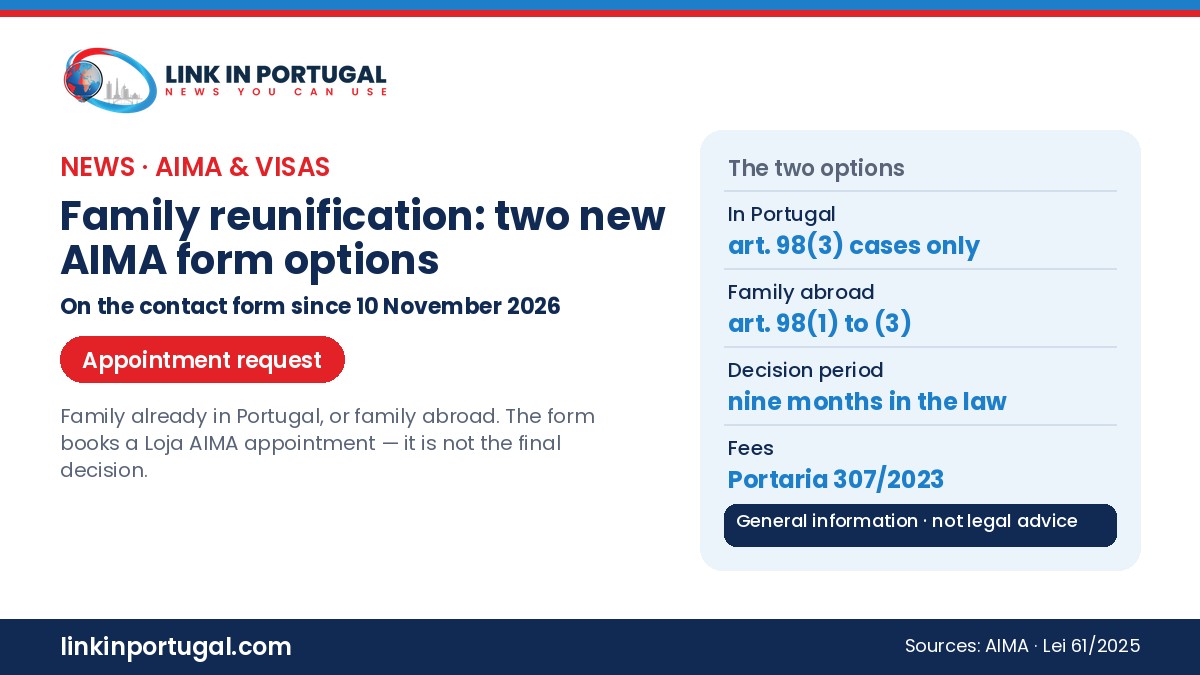
- Check which route is yours. Family abroad: in person at a Loja AIMA, by appointment. Family already in Portugal with at least one child under 18: online on the AIMA Services Portal (AIMA’s FAQ says the portal accepts only family members already in Portugal, and only when the household includes a minor).
- Gather the documents above, apostilled or legalised and translated where needed. Each file on the portal must be under 1 MB.
- Ask for an appointment through the AIMA contact form. If no option fits your case, AIMA says to email geral@aima.gov.pt with “Pedido de Agendamento” in the subject, your full name, date of birth, nationality, email and the reason, and to send it only once (AIMA FAQ). Our free AIMA email writer drafts this email in Portuguese.
- Pay the fees shown in AIMA’s fee table. Online requests get a 25% fee reduction, according to the same FAQ.
- After approval, a family member abroad applies for the residence visa at the Portuguese consulate or visa centre, then goes to AIMA after arriving in Portugal to get the residence permit.
AIMA appointments are free. Never pay a WhatsApp “agent” for a slot: see our scam warning and how to book an AIMA appointment.
How long the decision takes
The law says AIMA must decide within 9 months (article 105(1)). In exceptional, complex cases this can be extended once, by the same period, and you must be told. The extension isn’t allowed in the 2-year and 15-month cases of article 98(1) and (2) (article 105(2)).
If AIMA is silent: keep proof of everything you sent, answer every notification quickly, and use the contact form. If the deadline has passed, a lawyer can advise on a complaint to the Provedor de Justiça or a court action. Law 61/2025 now limits the urgent intimação against AIMA to cases where the delay seriously and directly harms your rights (article 87-B). See also how to check your AIMA status.
Integration measures after approval
After approval, family members must attend Portuguese language training and training on Portugal’s constitutional principles and values, and children must attend compulsory school (article 101(3)). When the family member’s permit is renewed, AIMA can check that this was done, unless it wasn’t their fault (article 101(4)). The law says the details will be set in a decreto regulamentar; we couldn’t find it published as of 5 October 2026.
Once your family is here, a baby born in Portugal needs its own numbers: see NISS for a baby born in Portugal. For your own permit, see temporary residence permit requirements.
FAQ
How long does family reunification take?
By law, up to 9 months from the request, extendable once in complex cases. Add the time for your appointment and, for family abroad, the consular visa afterwards.
Can I bring my parents?
Yes, your parents or your spouse’s parents, if they are in your care (dependent on you). AIMA accepts proof of economic dependence such as transfers you sent to them. The 2-year rule applies.
Reagrupamento familiar CPLP: can I apply with a CPLP permit?
AIMA’s portal FAQ says that, for now, only holders of a residence card (título de residência) can apply online, and that CPLP permit holders “should be included later”. Ask AIMA through the contact form about your case.
Do I need a lawyer?
Not by law. Many people apply themselves. A lawyer or solicitor is worth it if your case is unusual (for example, a marriage that may not be recognised in Portugal), if AIMA refuses, or if the deadline has passed.
My family member is already here without a visa. Can I still apply?
Only if they entered legally and are in the no-waiting-time group. Otherwise, speak to a lawyer before doing anything, because an irregular stay can lead to a visa refusal later.
Want a professional to check your case?
For advice on your own situation, speak to a certified accountant (contabilista certificado), a lawyer, or the official service. Questions or corrections about this guide? Contact Link in Portugal.
Official sources
- Diário da República – Law 61/2025 (new family reunification rules, articles 98–106)
- Diário da República – Law 61/2025, record page
- Diário da República – Foreigners Law (Lei 23/2007), consolidated text
- AIMA – Family reunification, family member outside Portugal (art. 98(1))
- AIMA – Services Portal FAQ (online family reunification for family already in Portugal)
- AIMA – Means of subsistence
- AIMA – Recognition of foreign documents
- AIMA – FAQ on appointments and official portals
- Diário da República – Decree-Law 139/2025 (minimum wage €920 in 2026)
- AIMA – Contact form
AIMA contact centre: +351 217 115 000 (Monday to Friday, 8:00 to 20:00, according to aima.gov.pt).
This guide is general information, checked against official sources on 5 October 2026. Rules and portals in Portugal change often, so confirm the current rules with the official source before you act. It is not legal or tax advice.

3 thoughts on “Family Reunification in Portugal: How to Bring Your Family (2026 Rules)”